

Certain metal roof systems can achieve at least 60 years of service life, and a building-owner survey reported an average of 41.6 years for metal roofing, compared with 23 years for modified-bitumen and built-up roofing, according to the Metal Construction Association's overview of metal roofing longevity. That changes the buying question: a nearby supply store isn't just a place to pick up screws. It's a source for components that need to work with the roof for the long haul.
Table of Contents
- Why Your Supplier Decides How Long the Roof Lasts
- Choosing Between a Store Visit and Online Ordering
- Vetting Checklist for Any Nearby Store
- Checking Fasteners, Underlayment and Snow Retention
- Verifying Counts, Pricing and Bulk Quotes
- Confirm the Order Before You Act
Why Your Supplier Decides How Long the Roof Lasts
A roof can have durable panels and still fail early at the details. A wrong fastener can corrode or leak. An incompatible sealant can cause trouble at a flashing. A snow-retention attachment that doesn't suit the panel can compromise the roof where it's supposed to hold.
That's why the counter price isn't the whole cost. Saving a few cents on each of several thousand screws looks useful on a quote, but one callback to replace a section of incorrectly fastened roof can erase the savings. The same goes for a substitute that doesn't meet the panel manufacturer's requirements: the lower unit price can bring added labor, delay, or premature repair.
A supplier should be able to help you confirm that each item matches the roof assembly, not just hand you a box with “metal roofing screws” on the label. If you're comparing panel thicknesses before ordering, this guide to understanding the different thicknesses of quality roofing metal can help you frame the questions to ask about the panel itself.
Before your crew waits on site, get three things in hand: a shortlist of nearby stores found by panel profile and county, a phone-confirmed stock and compatibility check, and a written quote before you pay a deposit.
Find, vet, compare buying channels, check specifications, verify counts and pricing, then confirm the order on the call.
Choosing Between a Store Visit and Online Ordering
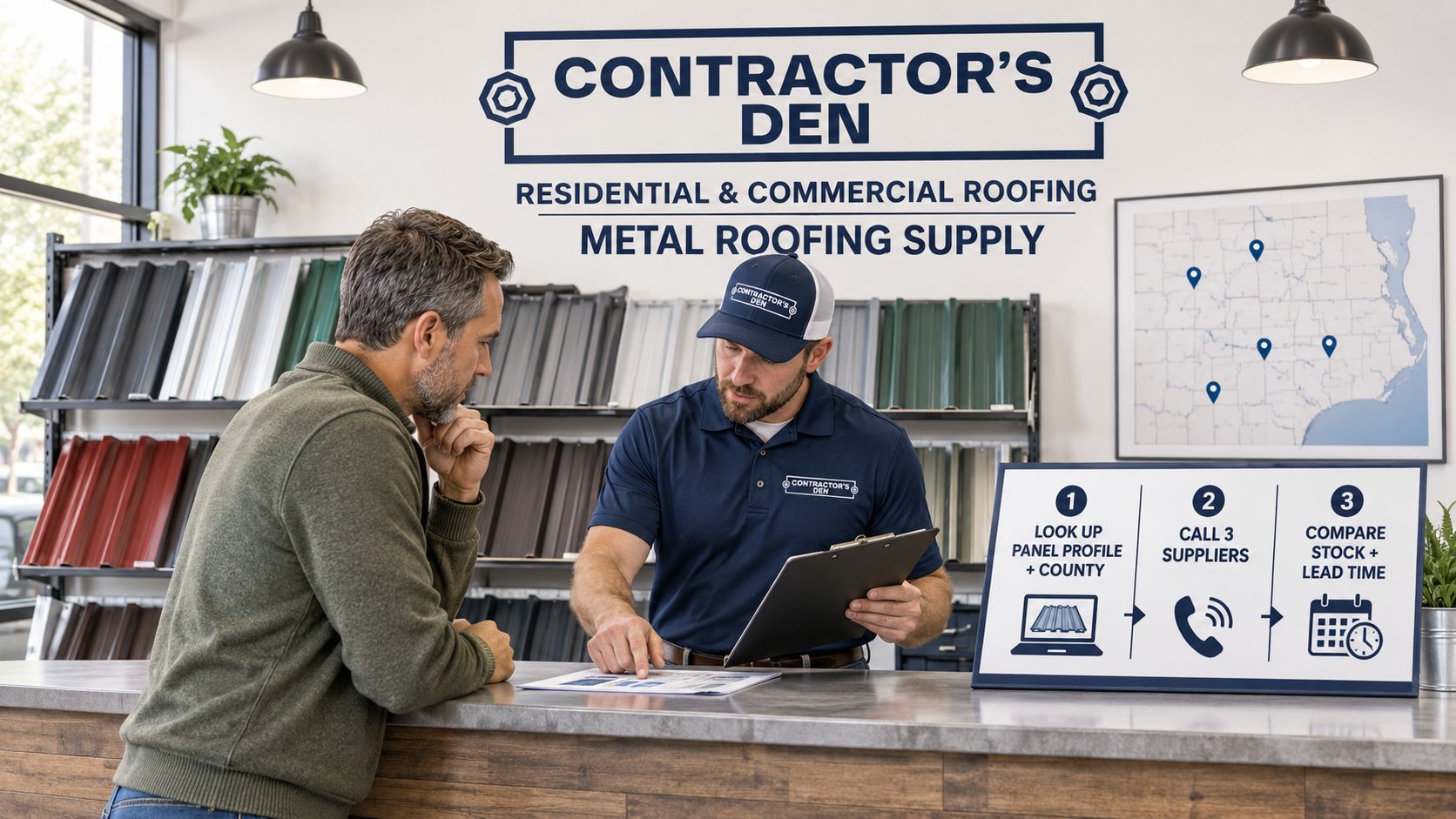
Start your search with the panel profile and county, not just “near me.” A standing-seam project and an exposed-fastener roof may need different panels, trim, and attachment details. Call three candidates and ask each for the same information: how many of your specific items are in stock, and what's the lead time for the approved item?
Choose the channel based on the work and the risk you can tolerate:
| Channel | Best for | Trade-off | Check first |
|---|---|---|---|
| Local counter store | Panels, trim, and same-day pickup | Thin fastener depth and sometimes limited stock | Stock count on your specific profile |
| Big-box home center | Common sealants and general fasteners | Staff may not know roofing-rated specifications | Whether the fastener is rated for metal roofing |
| Specialist roofing supplier with online ordering | Bulk counts, accessories, and samples | Shipping can run longer than local stock | Quote with a confirmed delivery date |
| Manufacturer or distributor route | Full panel systems with approved accessories | Minimum order sizes and longer lead times | Approved accessories list for the panel |
| Online-only accessory retailer | Fasteners, butyl tape, and snow guards | Goods can't be inspected in person | Sample and short-count policy |
A local store can be the fastest choice when it confirms the exact profile and quantity. But a trip to the counter doesn't help if the shop has panels and trim but not the specified screws, closures, or compatible sealant. Conversely, an online supplier may have the right accessory but ship it too late to keep the crew moving.
Lead times and prices can shift sharply. Roofing Contractor reported that tariffs and border inspections pushed some roofing-material lead times out six to eight weeks, while domestic metal premiums rose 54% in six weeks in its coverage of changing roofing supply conditions. Ask each store for the lead time on the approved item and on any proposed substitute, plus how long its quoted price holds.
Substitution rule: Common screws may be replaceable with a same-spec equivalent, but get written approval before substituting washers, sealants, flashings, underlayment, or snow guards. A cheaper alternative can conflict with installation requirements or warranty conditions, and a substitute that needs to be ordered can add days to the job.
For bulk accessory planning, compare the supplier's options with this guide to wholesale roofing accessories and installation efficiency. The nearest counter isn't automatically the cheapest or fastest choice. Count stock certainty, compatible replacements, delivery reliability, and the labor cost of waiting.
Vetting Checklist for Any Nearby Store
| Check | Ask or verify | Good answer | Red flag |
|---|---|---|---|
| Stock on hand | Count of your panel profile and fastener box sizes today | Specific count with lot or date | “We usually have it” |
| Fastener type | Metal-to-wood or metal-to-metal, drill point, and length | Matches your panel and substrate with a data sheet | Only one generic screw on the shelf |
| Coating and corrosion | Galvanized, mechanically galvanized, or stainless | Stainless steel for coastal jobs, matched coating otherwise | Plain zinc for a salt-exposed site |
| Substrate advice | Guidance for reroofing over existing decking | Pull-out test or manufacturer instruction | “Screws always hold” |
| Samples | Sample pack before a bulk order | Samples sent the same week | No sample policy |
| Written quote | Line items with quantities and waste allowance | Quote within one business day | Verbal estimate only |
| Price-match terms | Scope, proof required, and exclusions | Written terms you can read | “Match on request” with no terms |
| Count and returns | Short-count and reship policy | Documented reship process | No return policy |
| Support | Who answers and during which hours | Named contact with phone hours | Voicemail only |
Start with the stock answer. “We usually have it” doesn't tell you whether the store has your profile, color, length, or fastener box size ready for pickup. Ask for the count of the actual item and a lot or date reference, especially if the order depends on matching material already on site.
Next, listen for whether the counter staff asks what the screw is fastening into. A knowledgeable answer distinguishes metal-to-wood from metal-to-metal, and connects the drill point and length to the panel and substrate. If you're reroofing, the supplier shouldn't assure you that old decking will hold without a basis for that call. Review the relevant metal roof installation code considerations for contractors alongside the project documents and manufacturer instructions.
Then check what happens after the sale. A sample policy lets you compare a screw or sealant before committing to a bulk order. A line-item quote makes quantity and waste assumptions visible. Written price-match terms tell you which products qualify and what proof the store needs. The reship process matters if boxes arrive short, while a named contact and stated phone hours give you someone to call when the delivery doesn't match the order.
Score answers by risk, not by friendliness. A missing sample policy is something to negotiate. A red flag on fastener compatibility, substrate guidance, written pricing, or short-count resolution is a reason to call the next store. A good counter conversation should leave you with details you can verify, not a promise to “make it work.”
Checking Fasteners, Underlayment and Snow Retention
| Case | Requirement | Source |
|---|---|---|
| Coastal site within 3,000 feet of saltwater | Stainless-steel fasteners | Building America recommendation |
| Reroof over existing decking | Pull-out tests before trusting old decking to hold new screws | U.S. government guidance |
| Single-layer underlayment side laps | 2 inches minimum | NRCA technical manual |
| Single-layer underlayment end laps | 4 inches minimum | NRCA technical manual |
| Double-layer underlayment | 19-inch side laps and 4-inch end laps | NRCA technical manual |
| Backward laps with self-adhering underlayment | At least 2-inch horizontal laps with sealed, roller-pressed seams | RCABC standards |
| Screw penetration past the panel | About three threads | Independent building-science guidance |
| Loose fastener on a roof in service | Replace with a larger fastener and renew sealing | Educational guidance |
| Snow retention on a standing seam roof | Check seam height, snow load, and attachment capacity before buying | Manufacturer data sheet and local code |
Specify the roof assembly before comparing screw prices: panel type, substrate, exposure to salt or chemicals, design loads, and the manufacturer's approved fastener system all affect the order. Building America's metal roof guidance recommends stainless-steel fasteners for coastal environments within the distance shown in the table. It also advises verifying substrate capacity with pull-out testing during reroofing, rather than assuming existing decking will hold new screws.
Two mistakes cause avoidable problems at installation. First, “self-drilling” doesn't mean a screw can drill through any combination of panel and substrate. Check the drill point's maximum combined-material thickness, then use a torque-adjustable screwgun and drive perpendicular to the panel. Overdriving can damage the washer and reduce water resistance; underdriving can leave the seal incomplete.
Second, don't treat underlayment as a generic roll to spread across the roof. The lap pattern must fit the system and slope, and backward laps need the specified sealed, roller-pressed treatment. Confirm that tapes and sealants suit both the panel coating and flashing material. A practical guide to installing a metal roof from 7 Summits Roofing can help orient the work sequence, but the panel manufacturer's details and applicable local requirements control the final specification.
For snow retention, check the seam type, roof geometry, expected snow load, and the attachment capacity before ordering guards or rails. A product intended for an exposed-fastener panel may not attach appropriately to a standing-seam system. Use the panel and snow-retention manufacturer's instructions to select a layout, and see this guide to metal roof snow-retention systems for the distinctions between common options.
At receiving, inspect sample screws before accepting a bulk order. Check for damaged coatings, distorted washers, and mixed types, and make sure the diameter, length, thread configuration, drill point, and lot count match the order. For a metal-to-wood application, the #10 Fastgrip™ Selfdriller - Hi-Lo Metal to Wood screws are described as 1022 carbon steel fasteners with Hi-Lo threads and a MINI-DRILLER point, including increased performance when drilling through two layers of metal.
Verifying Counts, Pricing and Bulk Quotes
A quote is useful only if the quantities reflect the actual roof layout. Underlayment, flashing, boots, tapes, and snow retention should form a coordinated assembly rather than a generic shopping list. The RCABC technical updates on underlayment and accessory installation reinforce the need to account for slope, laps, penetrations, and compatible materials. Use this sequence to make your quote comparable across stores.
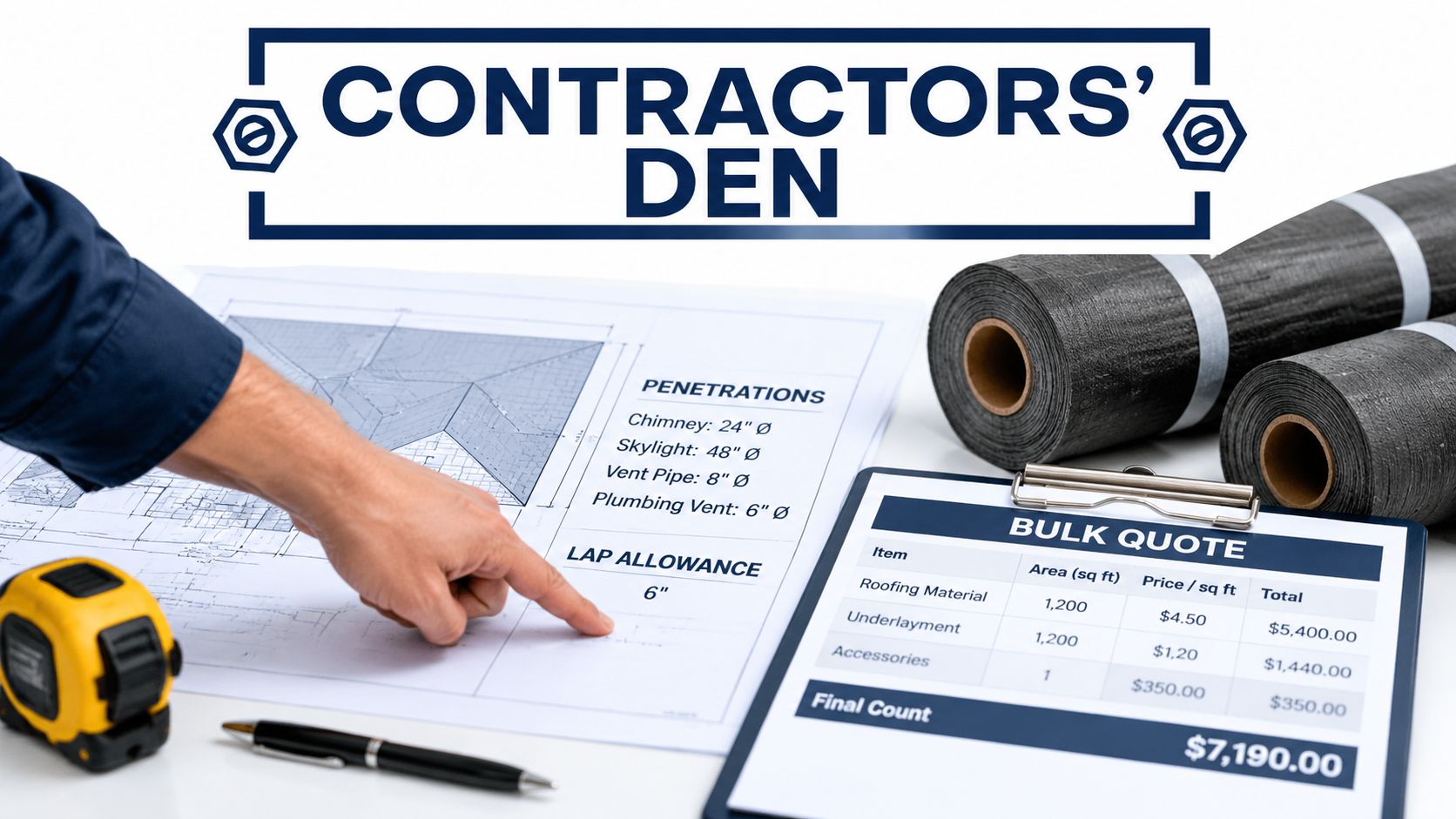
- Map the roof. Measure the roof area and mark eaves, rakes, valleys, low-slope transitions, and each penetration. Record every pipe or vent by diameter so you can match boots and flashing to the opening.
- Build the underlayment quantity. Start with measured roof area, then account for the selected product's lap pattern and the waste allowance you want listed on the quote. Don't compare rolls by count alone if suppliers are calculating coverage differently.
- Count fasteners from the layout. Use the panel area and accessory layout to calculate the order, then include spares for pieces that may be dropped or damaged. Keep metal-to-wood and metal-to-metal requirements separate so the quote doesn't combine unlike screws.
- Send every supplier the same list. Request a written, line-item quote showing quantities, waste allowance, delivery date, and freight charges. Identical inputs make it easier to see whether one supplier omitted trim, closures, or another small but necessary component.
- Get price-match terms in writing. Ask which competitor prices qualify, whether shipping is included in the comparison, and which products or conditions are excluded. A verbal promise can't tell you whether the final order will be matched.
- Check the delivery against the packing slip. Count boxes as they arrive and compare labels with the order. Photograph any short or damaged box before the driver leaves, then contact the named supplier representative with the order details.
- Compare the landed cost. Add unit prices and freight, then account for the labor cost of a delay and the risk of a short count. A lower unit price can cost more at the jobsite if the delivery date isn't firm or the crew has to stop for missing material.
For a separate per-area estimate as a cross-check, use this guide to metal roofing cost per square. Keep the supplier quote as the order document: it should name the specific products, quantities, delivery terms, and any approved substitutions.
Confirm the Order Before You Act
Use a short script so the supplier can confirm the details that matter. Read it aloud, fill in the brackets, and ask the counter staff to repeat the product and quantity back to you.
“I'm buying metal roofing for a [panel profile] roof at a [slope] pitch.
The substrate is [existing decking or new framing], and the fastener is [metal-to-wood or metal-to-metal], [length] long.
Can you confirm the count by box size today, with lot or date?
Please send a written quote with line items and a delivery date.
Can you ship samples this week?”
For a counter visit, bring a panel sample and one screw from the existing roof if you're repairing or matching a system. Compare the finish and washer on the shelf with your project needs, and ask the staff member to explain the fastener and lap requirements for your case. If the store can't identify the product by profile, substrate, and application, don't let an uncertain substitution become the crew's problem.
Before calling, organize the roof dimensions and material list with a roof estimate calculator. If local stock is thin, an online accessory supplier can use the same call script. Confirm its sample, price-match, delivery, and phone-hour terms directly rather than assuming they match another retailer's policies.
Go or no-go: Order only when the count is confirmed, the fastener and coating fit the application, the quote is written with line items, and the return or reship policy is documented.
Save the checklist and tick each row before sending a deposit.
Contractor's Den supplies metal-roofing fasteners and accessories, including screws, butyl tape, underlayment, flashings, sealants, and snow-retention systems, with bulk quotes and samples available. For your next order, send the panel profile, substrate, item counts, and delivery deadline, then visit Contractor's Den to compare the specified components and request a quote.