

You've got a bunk of 2x10 on the trailer, the tag reads ACQ, and the screws riding in the truck box say exterior on the label. Those are not the same promise. The gap between them is where most treated-wood callbacks begin, usually two summers after the job was signed off.
I put the preservative label and the wet-dry history of the connection ahead of the coating printed on the box, every time. Fastener material, coating thickness, moisture, size, head type, installation and the approval paperwork all follow from those two facts. Get the order wrong and you pay for it twice, once at the counter and again at the callback.
Table of Contents
- Why Old Fastener Habits Fail on Treated Wood
- Which Fastener Material Fits Your Lumber and Exposure
- Coating Options From Electroplated Zinc to 316 Stainless
- How Moisture and Preservatives Drive Fastener Corrosion
- Sizing and Head Types for Common Treated-Wood Jobs
- How to Install Fasteners in Treated Lumber
- Codes, Specs and Bulk Orders for Treated-Wood Fasteners
Why Old Fastener Habits Fail on Treated Wood
January 2004 split two fastener specs that still share a jobsite. Residential pressure-treated lumber in the US moved off chromated copper arsenate (CCA), a preservative built on arsenic and chromium, and onto copper-based treatments such as alkaline copper quaternary (ACQ) and copper azole. That shift followed a 2003 voluntary agreement between leading wood-preservative suppliers and the US Environmental Protection Agency, as the Forest Products Laboratory explains.
A leftover bucket labeled exterior was a fair call on the older CCA stock. On an ACQ deck the boards can stay sound while the fasteners do not. Rust streaks follow the joist lines, brown weeping starts under the heads, and a few shanks thin out until the driver bit spins.
Practical rule: the treatment tag, and whether the joint stays wet, writes the fastener spec. The coating name on the box comes last.
ACQ puts more available copper in the wood. That copper is harder on ordinary steel, electro-galvanized fasteners, and some galvanized hardware than CCA was. The screw did not get worse between those jobs. The lumber got more aggressive, so a fastener that was acceptable in CCA stock does not transfer to a modern treated deck on habit alone.
Fasteners for today's treated lumber need an explicit approval for treated-wood contact. Hot-dip galvanized steel and stainless steel are the usual specifications. I reach for stainless where salt air, fertilizer, industrial fallout, or a joint that never dries will keep working on the coating. The word exterior on an old bucket is not that approval.
Which Fastener Material Fits Your Lumber and Exposure
Pick the exposure row first and the product second. That single habit prevents most of the expensive mistakes, because the row tells you how much water and chloride the connection will see.
| Exposure | Recommended material | Avoid |
|---|---|---|
| Dry interior or covered framing | Hot-dip galvanized, approved for treated wood | Electro-galvanized zinc |
| Exterior deck boards and fences | Hot-dip galvanized or 304 stainless | Electroplated zinc or plain steel |
| Ground contact or persistently damp joints | 304 or 316 stainless | Any zinc-only coating |
| Coastal, salt air, fertilizer or industrial | 316 stainless | Any galvanized coating in direct salt spray |
Reading the rows the way water reads them
The rows are ordered by wetness, not by price. Covered framing dries out and stays dry. Deck boards get rained on and dry between storms. A post base, a ledger or a rim-to-deck detail sits in ground contact and never fully dries. Coastal air adds chloride to everything, including the parts of the assembly that never see a puddle.
Work through four steps before you write a purchase order.
- Read the preservative off the tag. ACQ, copper azole or another copper system, each with its own fastener recommendation. If the tag is faded or missing, ask the yard for the treatment designation before you buy a single box.
- Rate the exposure from the matrix. Use the wettest condition the connection will meet in service, not the average over the year. A north-facing deck under a roof overhang still counts as exterior.
- Check for contact with dissimilar metals. Aluminum flashings, aluminum trim coil and aluminum accessories in direct contact with copper-bearing lumber and steel fasteners create a galvanic couple. Isolate the interface or change the component.
- When two rows apply, take the more conservative one. A deck on the coast is a coastal detail, not a deck detail.
A fastener is only acceptable when its listing or the manufacturer's published data says it is approved for contact with treated wood. The word galvanized on its own settles nothing. If you want to see how quickly an unapproved screw lets a deck down, why cheap screws ruin treated decks tracks the same failure pattern from the board side.
Roof-to-wood connections add their own twist, since the fastener passes through metal before it ever reaches lumber, and metal roofing screw types and materials is worth reviewing before you commit a panel schedule.
Confirm three things before ordering: the lumber tag, the exposure row and the written approval statement. If any one of them disagrees, stop and resolve it.
Coating Options From Electroplated Zinc to 316 Stainless
Coating names tell you less than coating thickness and approval do. Two screws can both be called corrosion resistant and sit at opposite ends of the durability range.
| Coating or metal | Typical use | Relative protection | Main caveat |
|---|---|---|---|
| Electroplated zinc | Dry interior, light duty | Lowest | Thin coat; not recommended with ACQ |
| Hot-dip galvanized | Exterior decks, fences, treated framing | Moderate to high | Corrosion varies widely in ACQ |
| Polymer-coated screws | Decks and siding | Depends on coating integrity | Check for damage at the drive point |
| 304 stainless steel | Exterior, non-coastal, damp | High | Not the choice for salt spray |
| 316 stainless steel | Coastal, pool, fertilizer | Highest listed here | Higher cost |
| Silicon bronze or copper | Compatible connectors | High | Use only where metals are compatible |
Ranking the coatings from thinnest to thickest
Electroplated zinc goes on in a bath at a thickness measured in fractions of a mil. It's fine for interior straps and dry framing, and it's the wrong coat for lumber that stays damp, because the zinc is consumed long before the deck reaches the end of its life.
Hot-dip galvanizing immerses the fastener in molten zinc and forms a metallurgical bond many times thicker than plating. It suits exterior deck framing and fence work, but the protection is not a guarantee against copper-bearing preservatives. Long-term data on hot-dip galvanized steel in ACQ-treated wood shows reported corrosion rates from about 2 to 113 micrometres per year, which is the USDA research range and a fair warning that coating weight, retention, moisture and temperature are read together.
G185 is not a fastener grade. It's a zinc coating weight for sheet steel, 185 g per square metre, and it describes the panel or trim, not the screw going through it. Ask for hot-dip galvanizing on the fastener itself and get the coating weight in writing.
Polymer-coated screws live or die on coating integrity. Look at the drive point and the underside of the head after a few test drives. A coating that chips at the tip exposes bare steel exactly where water collects.
Stainless steel splits into two working grades. Type 304 handles most non-coastal exterior and damp framing. Type 316 earns its price in salt air, pool enclosures and fertilizer exposure, and the A4 designation on European spec sheets is the same grade, which stainless grade advice from Neasden Hardware explains for anyone comparing labels across suppliers.
Silicon bronze and copper belong in compatible connector assemblies, not as a general substitute. Mixing them with galvanized hardware in a wet joint is a shortcut to a galvanic cell.
Simpson Strong-Tie runs its cited ASTM B117 salt-spray evaluation for approximately 1,440 hours before fasteners are assessed for corrosion, according to the company's technical resource page. Salt spray and treated-wood corrosion tests measure different conditions, and neither one predicts service life in years. Rank coatings by exposure first and price second.
How Moisture and Preservatives Drive Fastener Corrosion
A fastener can look sound when installed and still corrode early if water stays around it. In treated wood, copper-based preservatives, the fastener's metal and moisture combine in an electrochemical reaction. The wet board behaves like a battery: copper participates in the reaction, the fastener can lose material, and water carries the current. As the wood dries, that reaction slows.
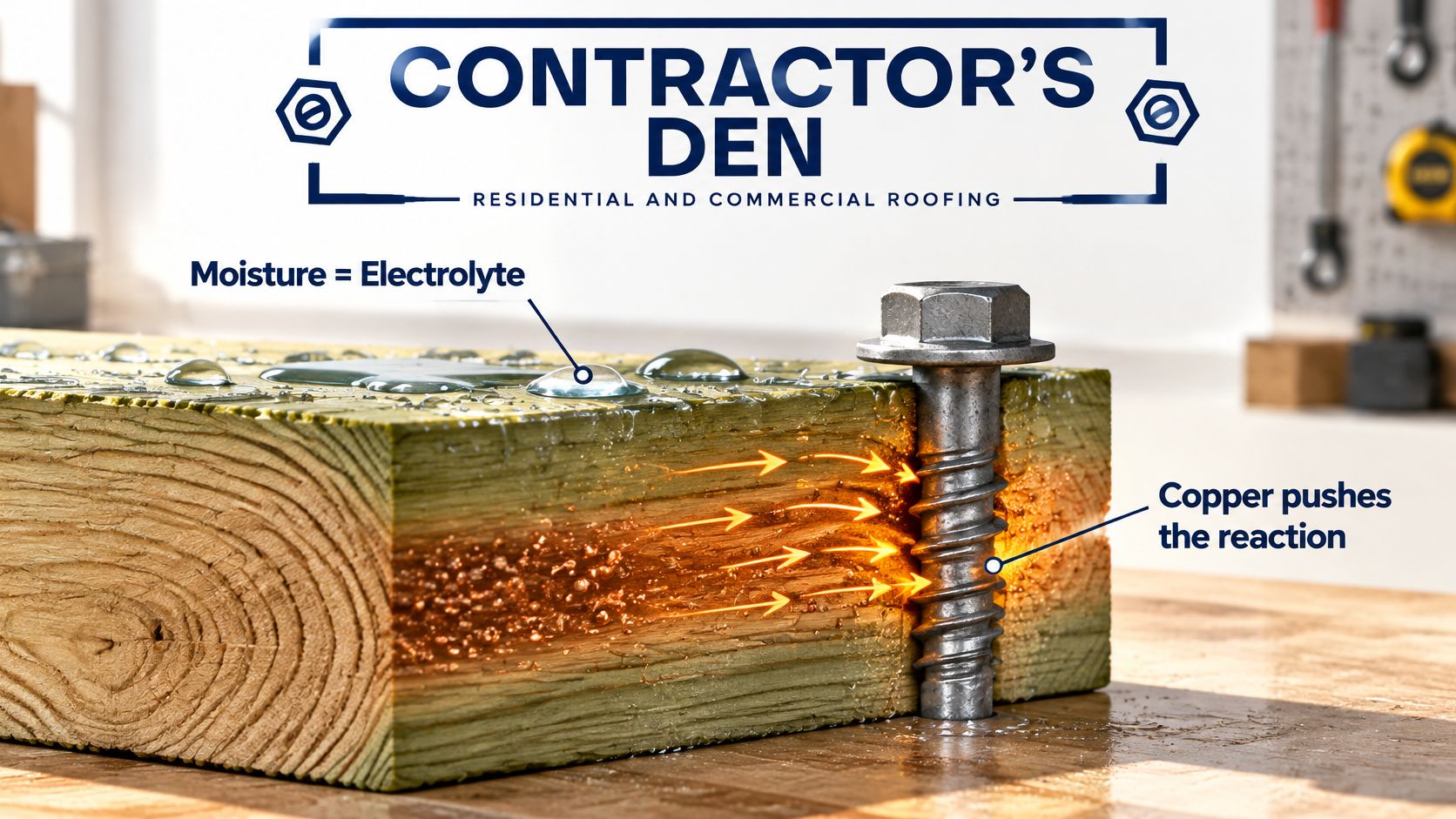
The Forest Products Laboratory review cited in the first section compares corrosion rates across preservative systems. Those figures describe tested conditions, not a service-life estimate for a particular deck or roof. The practical takeaway is that the lumber's preservative label belongs in the fastener specification, alongside its moisture exposure.
The moisture threshold that decides the job
Embedded metal generally shows little or no corrosion below roughly 15 to 18 percent wood moisture content. Above that range, corrosion rises with moisture before eventually reaching a plateau, according to USDA research on treated-wood corrosion.
Check moisture on site with a pin-type meter, taking readings in the wood near the connection rather than relying on surface feel. Take more than one reading if the assembly has wet and sheltered areas. A reading is a snapshot, so consider whether the joint can drain and dry after rain.
A ventilated crawlspace joist and a deck-ledger end-grain joint can have very different moisture conditions, even when they use the same lumber and fastener. Ledgers, roof edges, penetrations and trapped joints hold water longer. Coastal exposure adds chloride to the same connection, which can change the required specification; Miami-Dade County corrosion-resistant screw requirements address that exposure.
Replacing every fastener is the wrong first move. Correct the water path, then assess fasteners in connections that stay wet. AWPA E12 is an accelerated test using severe temperature and humidity conditions; it supports comparisons, not a prediction of how many years a fastener will last.
- Trace the moisture path. Identify where water enters, where it collects and whether it can drain.
- Protect cut ends and drilled holes. Fresh cuts expose wood that can hold moisture against the fastener shank.
- Find trapped water. Back-primed boards, double-layer rims and sealed joints without drainage can keep connections damp.
- Separate structural from replaceable connections. A ledger or hold-down deserves a more conservative material choice than a replaceable fence-picket bracket.
Sizing and Head Types for Common Treated-Wood Jobs
A fastener can be long enough and still be the wrong choice for the job. Match its length to the receiving member, then choose a head that suits the material and the finish.
| Application | Typical fastener | Head type | Typical size |
|---|---|---|---|
| 5/4 deck boards to joists | Coated or stainless deck screw | Bugle or flat | About #9 by 2-1/2 in |
| 2x treated framing and sill plates | Hot-dip galvanized nail or structural screw | Nail or round | 16d (3-1/2 in) or per code |
| Deck ledger to rim | Structural lag screw or through-bolt | Hex | Per code-listed schedule |
| Fence boards | Ring-shank or deck screw | Bugle | About 1-5/8 to 2-1/2 in |
| Metal roof panels to treated wood | Stainless pancake or coated roofing screw | Pancake or hex washer | Set by panel and deck thickness; confirm with the panel manufacturer's data |
What each head does on the material
Bugle heads seat flush in decking and reduce face tearing. Their underside helps form a countersink in softwood, making them a common choice for 5/4 boards.
Flat heads countersink for a flush finish on trim and fascia. Pancake heads spread clamping force across a broad, low-profile area, which helps avoid a raised bump on metal panels. Hex washer heads provide a socket-drive option and a bearing surface for metal-to-wood connections.
For metal panels over treated purlins, the #10 Logrip™ - Hi-Lo Metal to Wood screws are a Hi-Lo metal-to-wood option. Choose the screw length to suit the panel and receiving wood, and follow the panel manufacturer's specifications.
Length must provide the required engagement in the receiving member. A deck board screw is often about 2-1/2 inches, while a 2x rim connection needs a longer fastener; use the manufacturer's stated penetration depth rather than guessing. For roof work, use the panel manufacturer's data to match fastener length to the panel profile and deck thickness. The roof flashing nails and their placement also matter at flashing penetrations.
A ledger, hold-down, lateral restraint, or other load-bearing connection requires a code-listed schedule. Have an engineer specify the connection rather than selecting a length by rule of thumb.
How to Install Fasteners in Treated Lumber
A deck board still wet from the yard, a ledger stamped for ground contact, and a box of screws that never names treated wood: that job fails in the first season, whatever the coating is called. Read the preservative label and how wet the lumber still is before you pick a finish. Then run this sequence so the chemistry is not the weak link.
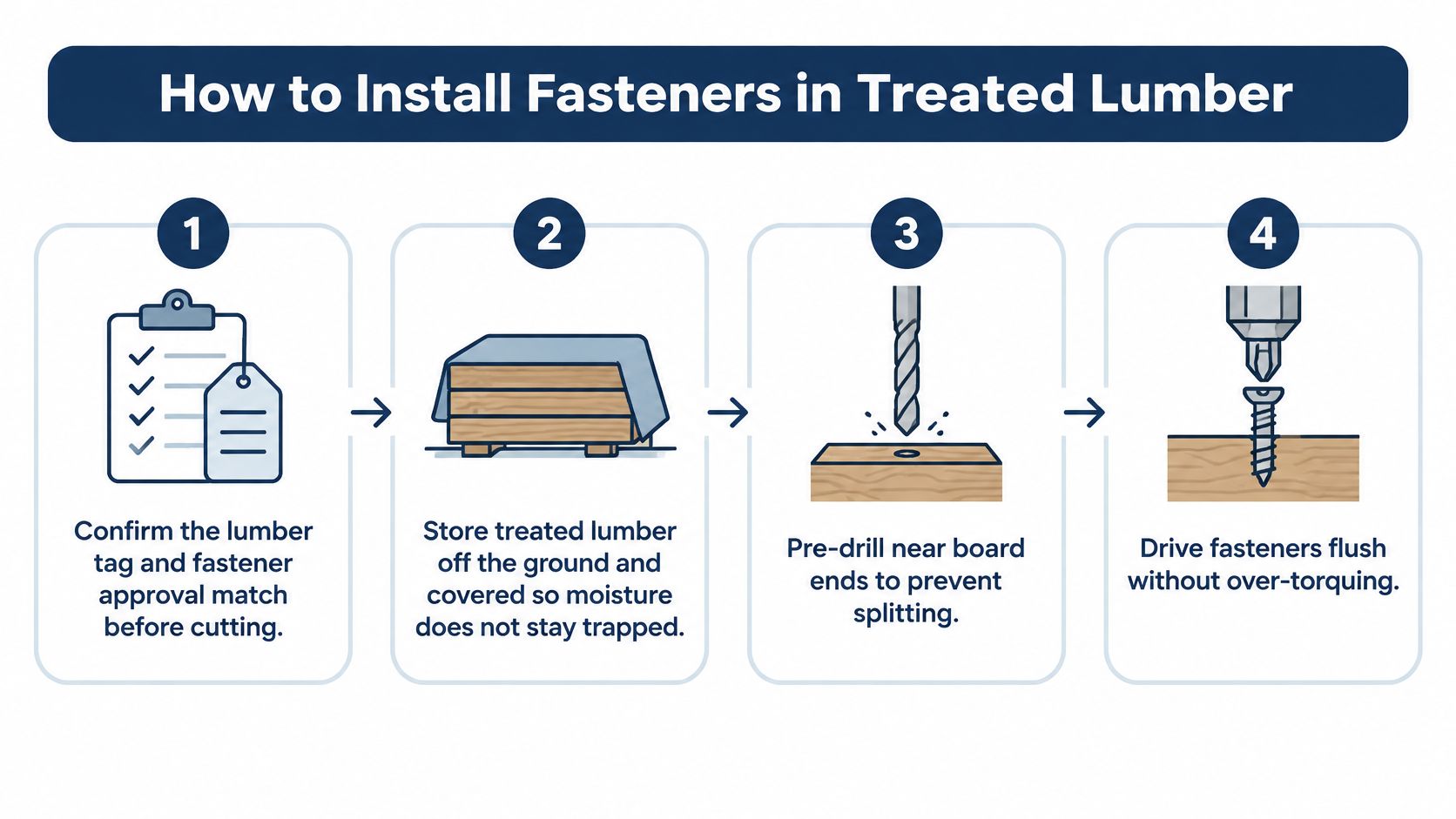
- Match the tag to the approval before you cut. Read the lumber label and the fastener listing side by side. Ground contact and higher retention change what the fastener has to survive. If the listing does not name treated wood, the box goes back.
- Store the lumber off the ground and covered. Wet bunks keep moisture in the stack for weeks. Fasteners driven into saturated boards start in wood that is still wet, so corrosion and movement begin before the connection sees weather. Cover the top and leave the sides open for air.
- Pre-drill near board ends and in end grain. A pilot hole slightly under the shank's root diameter stops the split that otherwise opens a direct path for water.
- Keep fasteners on the joist and off the board edge. Stay inside the manufacturer's stated edge distance, and don't crowd two fasteners into a short end grain run.
- Seal every penetration through metal. Use the screw's integral washer, seat it against the panel, and don't stack a second washer on top.
- Drive to seat, not past it. Over-torquing crushes the washer, cracks the coating, and puts bare steel where water sits. Stop when the washer seats and the panel stops moving.
- Touch up cut ends and drilled holes. Field-applied preservative or zinc-rich paint on fresh cuts and drill spoil, per AWPA M4, restores the barrier where the fastener now sits against exposed wood.
- Inspect ledgers closely. Retained moisture and higher preservative retention show up fast. A 2025 Journal of Light Construction article reported a UC4B-treated ledger causing significant hardware corrosion in less than six months, while a UC4A-treated joist in the cited example did not corrode its joist hanger.
When the connection runs through a metal panel into treated wood, the driving sequence and the seal matter as much as the coating on the screw. Five tips for through-fastened panel installation covers where the fastener lands relative to the rib and the washer.
On OSB and plywood under a roof panel, pull-out usually governs. Match the length to the sheathing plus the purlin, not to the panel alone. A type 17 point starts cleanly in that stack. Seat the washer once. I would rather leave a little washer compression than spin the coating off chasing one more click.
Codes, Specs and Bulk Orders for Treated-Wood Fasteners
A fastener specification starts with the lumber tag and the project exposure. Code language and product catalogs may not use the same terms, so identify the preservative first, then confirm the fastener's material and approval for that application. The 2006 International Building Code and International Residential Code recognized four broad fastener-material categories for contact with treated lumber: stainless steel, hot-dip galvanized steel, copper and silicon bronze. Electro-galvanized nails and screws, common with CCA lumber, were identified as unsuitable for long-term exposure to newer ACQ and copper-azole preservatives, as the American Wood Council Institute feature explains.
The International Code Council developed acceptance criteria for treated-wood fastener corrosion, including AC-257, effective January 1, 2009, as described in the ICC acceptance criteria for corrosion-resistant fasteners. Code editions change; confirm the current edition and the fastener's approval rather than relying on an older product sheet.
The standards a buyer is likely to see
Two ASTM documents may appear in submittals and product literature. ASTM G198-17(2023) is a treated-wood fastener corrosion test method; ASTM G16-13(2024) guides the application of statistics to corrosion data. Both designations appear in the 2025 ASTM standards catalog.
Local jurisdictions adopt code editions on their own schedules. For connectors, check the code evaluation report and verify that it names the fastener you intend to use. The guide to local building codes and regulations can help clarify why the governing edition matters to a project's specifications and inspections.
Building a spec line you can send
Put the lumber-tag preservative and the project exposure in the spec line, then identify the fastener and its required documentation. Include head type, length, required penetration and approval listing so a supplier can quote the intended product rather than a close substitute.
Spec line: preservative per lumber tag, exposure zone from the drawings, fastener material and coating, head type, length with required penetration, and approval listing.
For bulk orders, calculate fasteners per joist and panel from the spacing schedule. Include an overage for waste and split-driven rejects, then order by box count to avoid running short before the last row. Request coating data, the approval listing and a sample before committing to a pallet; a quote tied to the spec line helps catch substitutions before shipment.
Lumber care affects moisture exposure too. Drying, sealing and drainage influence how much moisture reaches the fasteners; this guide to treated lumber finishing and longevity covers that part of the assembly.
Contractor's Den specializes in fasteners, screws and caulking for metal roofing, and offers bulk ordering, quotes and free samples. Its catalog includes metal-to-wood fasteners, roofing underlayment, low-slope products, pipe flashings, sealants and snow retention systems. For a metal-roofing specification, the store can provide product information and a quote for the selected line items.
Contractor's Den sells metal roofing fasteners, including pancake-head metal-to-wood fasteners in 300 Series stainless steel, along with butyl tape and sealants. Visit Contractor's Den to review product details or request a quote.